Open on Wednesdays, Saturdays and Sundays
10:00 am – 5:00 pm

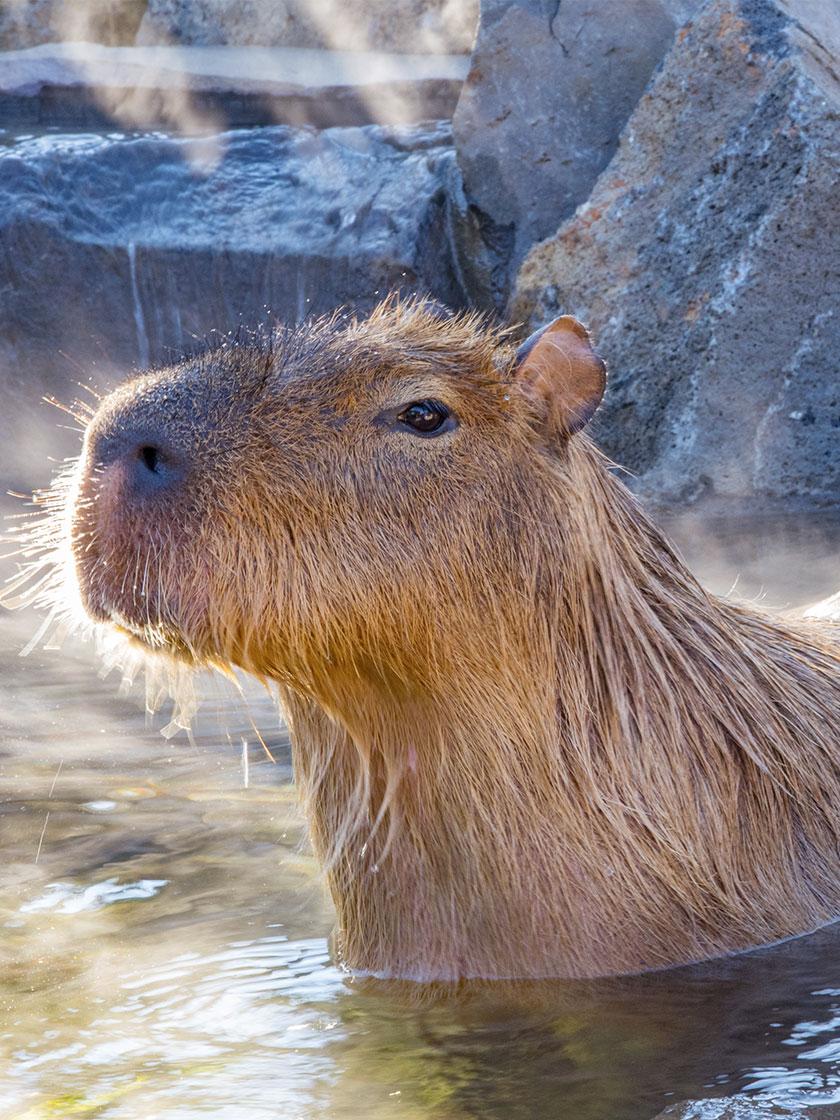
Aquatic habitats, including marshes, swamps, and riverbanks. They are found in tropical forests and grasslands.

Argentina, the Plurinational State of Bolivia, Brazil, Colombia, Ecuador, Guyana, Paraguay, Peru, Uruguay, and the Bolivarian Republic of Venezuela.

Head and body: 107–134 cm Tail: 1–2 cm

35–65 kg

Up to 10 years in the wild
Up to 15 years in captivity

120–150 days

Herbivore

La liste rouge mondiale de l’UICN des espèces menacées
Depuis les années 1960, l’Union Internationale pour la Conservation de la Nature publie la Liste rouge des espèces menacées. Les espèces sont classées dans des catégories indiquant le degré de menace auquel elles sont confrontées.
List the species that have not yet been assessed against the Red List criteria.
Includes species for which the best available data are insufficient to determine, either directly or indirectly, their risk of extinction.
List the species that are at low risk of extinction in the region in question.
Includes species that are close to meeting the quantitative thresholds for threatened species and that could become threatened if specific conservation measures are not taken.
Includes species threatened with extinction. Relatively high risk.
Includes species threatened with extinction. High risk.
Includes species threatened with extinction. Very high risk.
Refers to species that survive only in captivity or as part of a naturalized population.
A species of which there is no doubt that the last individual has died.
Four capybaras live at Parrot World: three females and one male. They share the large Amazonia Trek aviary, which covers more than one hectare, with free-flying parrots, flamingos and turtles. Calm and sociable, they live alongside their neighbours without the slightest tension.
Every day, the keepers prepare fresh fruit and vegetables for them, mostly leafy greens, served in two meals, morning and evening. They also have unlimited hay, which is essential for wearing down their teeth as these never stop growing, and pellets enriched with vitamin C, which their bodies cannot produce.
In summer, they enjoy long mud baths: the mud cools them down and protects their skin from the sun.
Want to get closer? With Zookeeper for a Day, you help look after them alongside the animal care team.
Capybaras live in groups, usually of ten to twenty animals led by a dominant male. They communicate through whistles, clicks and short alarm barks.
The capybara is semi-aquatic. Its feet are partially webbed. Its eyes, ears and nostrils sit high on its head, as on a hippopotamus, so it can see and breathe while almost completely submerged. When in danger, it dives and can hold its breath for up to five minutes.
Its predators are the jaguar, the puma, the caiman and the anaconda.
The capybara is a strict herbivore. It grazes on riverbank grasses and aquatic plants, and can eat several kilos of vegetation a day. Its name comes from Tupi, an indigenous South American language, and means “grass eater”.
After a gestation of four to five months, the female gives birth to four or five young on average. They are born with their eyes open and a full coat of fur, and follow the group within hours. After a week, they start grazing.
The capybara is not endangered: the IUCN lists it as “Least Concern”. It is still hunted for its meat and hide in parts of South America.
Its popularity on social media sometimes makes people want one as a pet. Yet the capybara is a wild animal: it needs a group, a body of water and plenty of space. It is not a pet.
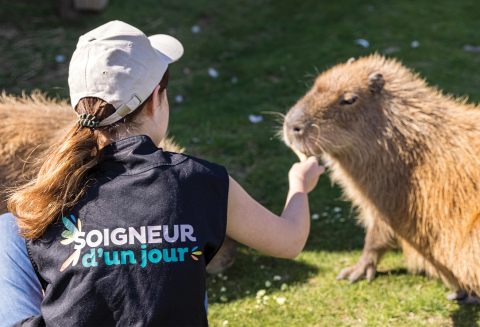
Want to see capybaras in a different way?
Join our animal care staff and get an up-close look at the daily lives of these fascinating rodents, while discovering other iconic species at the park.
Looking for a family day trip from Paris? Parrot World is a unique wildlife park where kids can see capybaras and many other animals in an immersive setting.
Adult rate (ages 14 and up): €170
Child rate (ages 8–13): €90
A unique experience to enjoy with your family, perfect to include during a day trip or a stay near Disneyland Paris.
Discover the best things to do near Disneyland Paris
Plan your visit to the park


Yes, capybaras can be seen in some wildlife parks. At Parrot World, they live in an immersive environment inspired by their natural habitat.
You can see capybaras at Parrot World, one of the best things to do near Disneyland Paris, perfect for a family day out.


